








Why pStable was developed
Advances in synthetic biology have transformed what researchers can build. Today's projects routinely involve long DNA constructs, multi-gene pathways, engineered viral genomes, synthetic regulatory networks, and increasingly complex genetic architectures.
As construct complexity grows, however, maintaining those sequences in bacterial hosts can become a challenge.
Researchers sometimes encounter unexpected problems during propagation, including poor colony growth, low plasmid recovery, sequence rearrangements, deletions, or instability that emerges after cloning. In many cases, the issue is not DNA synthesis itself but the ability of E. coli to faithfully maintain the construct over multiple generations.
pStable was developed specifically to address these challenges. Rather than focusing primarily on maximizing plasmid yield, the vector was engineered to improve construct stability during propagation while still providing a mechanism to increase plasmid production when needed.
Why some DNA constructs Are difficult to maintain
Not all DNA sequences place the same demands on a bacterial host.
Constructs containing large inserts, repetitive DNA, viral sequences, complex regulatory regions, high-complexity sequence architectures, or toxic genes can create additional pressure on bacterial cells. Over time, this pressure can contribute to growth defects, recombination events, rearrangements, or deletions that alter the original construct.
Traditional cloning vectors often rely on moderate or high plasmid copy numbers. While this can simplify plasmid preparation, it also means the host must maintain many copies of a potentially challenging construct.
pStable takes a different approach.
The Core innovation: Low-copy propagation
The defining feature of pStable is its inducible low-copy architecture.
Rather than maintaining a difficult construct at elevated copy number throughout propagation, pStable is designed to remain at a very low copy number during routine growth. By reducing the number of plasmid molecules that must be replicated and maintained, the vector can help create a more favorable environment for challenging sequences.
This approach may be particularly beneficial for constructs that are:
- Large or complex
- Repetitive
- Toxic to bacterial hosts
- Difficult to clone using conventional vectors
- Viral in origin
- Part of large synthetic biology assemblies
For these applications, maintaining stability may be just as important as generating high plasmid yields.
Key technical features of pStable vectors
Inducible low-copy replication: pStable is designed to propagate at extremely low copy number during routine growth conditions. This feature helps reduce the cellular burden associated with maintaining difficult DNA constructs.
On-demand copy number induction: Unlike fixed-copy plasmids, pStable allows researchers to increase plasmid copy number when additional DNA is required for downstream applications.
Replication control via the ara regulatory system: The vector incorporates ara regulatory components that regulate plasmid replication. These elements control copy number rather than functioning as a traditional expression system for the inserted gene.
Multiple antibiotic selection options: Available vector formats include ampicillin and kanamycin for insert lengths up to 7.5kb. For XL genes (>7.5kb length), pStable with chloramphenicol resistance is required.
pStable vector map overview: Include vector maps for the available pStable formats to help researchers compare backbone features, antibiotic selection markers, and insert-size use cases.
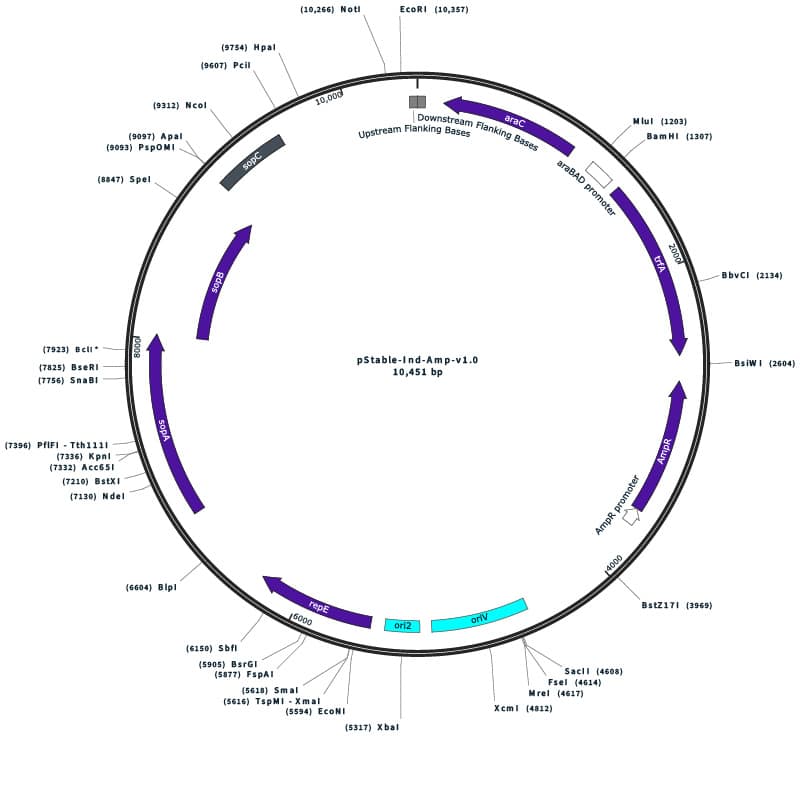
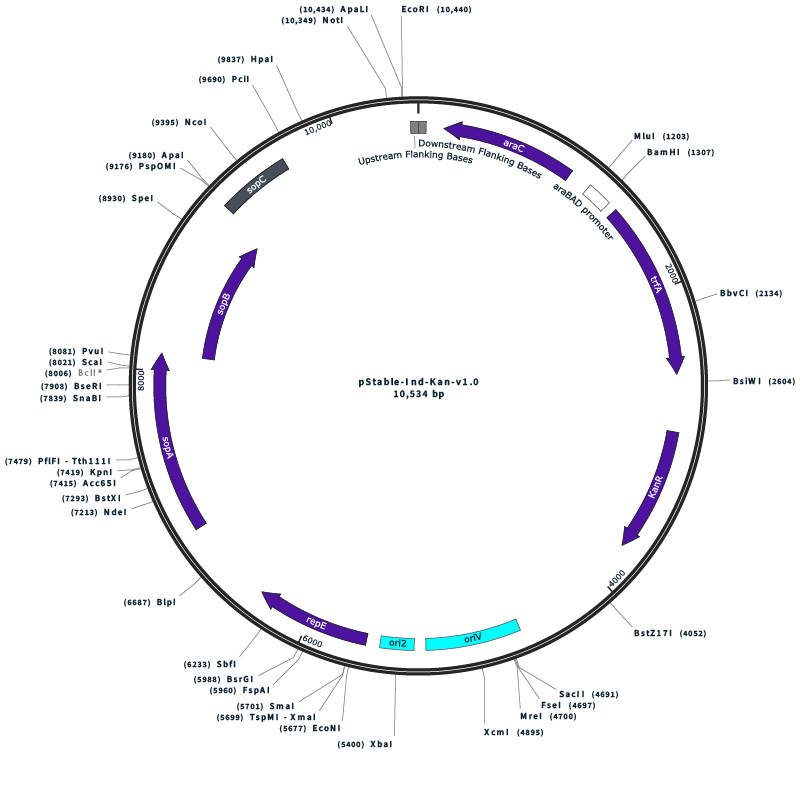
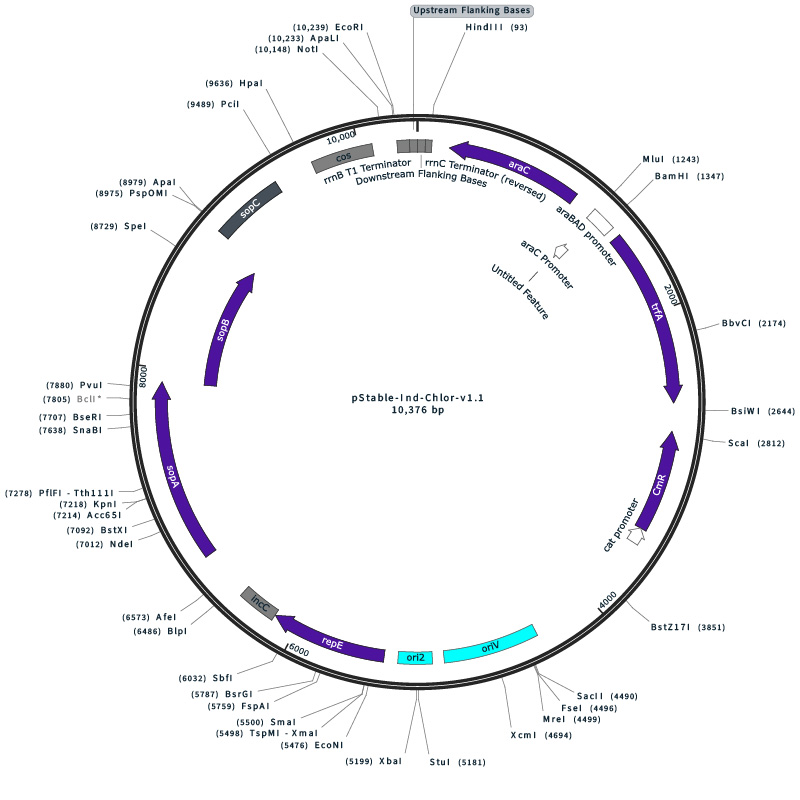
Compatibility with Downstream Applications
pStable remains compatible with common cloning workflows, including Golden Gate Assembly, while providing enhanced support for difficult constructs. Researchers should, however, consider the larger backbone size during experimental design.
How glucose and arabinose work in pStable workflows
One of the most unique aspects of pStable is its ability to separate construct maintenance from plasmid production.
During routine propagation, glucose is used to maintain the vector in a low-copy state. Under these conditions, plasmid copy number can be reduced to approximately one copy per cell, helping minimize the burden placed on host cells by difficult constructs.
Once the construct has been successfully propagated, arabinose can be introduced to induce higher plasmid copy numbers. Under induced conditions, plasmid copy number may increase substantially, allowing researchers to recover greater amounts of plasmid DNA for downstream applications.
This creates a two-stage workflow:
Propagation Phase
- Glucose maintains low-copy conditions.
- Construct stability is prioritized.
- Cellular burden is reduced.
Production Phase
- Arabinose increases plasmid copy number.
- Additional DNA can be recovered for plasmid preparation and downstream workflows.
Importantly, arabinose in pStable does not directly induce expression of the gene of interest. The ara regulatory system controls plasmid replication rather than target-gene transcription.
Research scenarios where pStable can make a difference
Building large synthetic biology constructs: A researcher assembling a multi-gene pathway may be working with a construct that contains multiple regulatory elements and large DNA payloads. As construct size increases, maintaining plasmid integrity can become increasingly challenging. pStable's low-copy architecture can help support propagation of these larger assemblies.
Cloning toxic genes: Certain genes or gene products can negatively impact bacterial growth. Even low levels of unintended expression can make constructs difficult to maintain. By reducing plasmid copy number during propagation, pStable can provide a more accommodating environment for such constructs.
Working with repetitive DNA: Repetitive DNA sequences are often associated with cloning instability and recombination events. Researchers studying repeat biology or developing synthetic repeat architectures may benefit from a stability-focused propagation strategy.
Developing viral or vaccine constructs: Viral genomes and viral genome fragments frequently present propagation challenges. pStable's stability-focused design can be useful when maintaining these complex sequences.
Producing XL genes: Large DNA constructs require specialized propagation strategies. pStable-Chlor is used for XL Gene Synthesis workflows and was developed to support successful maintenance of larger DNA payloads.
Recovering difficult synthesis projects: Some constructs prove difficult to manufacture or propagate in standard cloning vectors. pStable-Ind vectors can serve as an alternative backbone option when instability, toxicity, or sequence complexity presents challenges.
Troubleshooting common pStable workflows
Low plasmid yield
Researchers transitioning from traditional high-copy cloning vectors may initially observe lower plasmid yields. This behavior is often expected because pStable is designed to maintain low-copy conditions during propagation. Higher yields are typically achieved during induction.
Arabinose doesn't increase gene expression
This is a common misconception. In pStable, arabinose regulates plasmid replication rather than directly activating gene expression. The system is designed to increase plasmid copy number, not function as a dedicated expression system.
Poor recovery of large constructs
Transformation efficiency can decline as plasmid size increases. For constructs larger than 20 kb, electroporation is recommended to improve recovery.
When should I use pStable instead of a standard vector?
Many constructs perform well in conventional cloning vectors. However, pStable may be worth considering when projects involve:
- Long DNA constructs
- Repetitive sequences
- Toxic genes
- Viral genomes
- Multi-gene assemblies
- Previous propagation failures in standard vectors
Will pStable work with my downstream cloning workflow?
The vector remains compatible with common cloning applications, including Golden Gate Assembly. Researchers should account for the larger backbone size when designing downstream experiments.
Technical snapshot: pStable at a glance
| Feature | Benefit |
|---|---|
| Low-copy propagation | Reduces selective pressure on difficult constructs |
| Arabinose-inducible copy number | Increases plasmid yield when needed |
| Glucose-mediated repression | Supports stable low-copy maintenance |
| ara regulatory system | Controls plasmid replication rather than expression |
| trfA, cos, and sop elements | Support stability and plasmid maintenance |
| Multiple antibiotic marker options | Provides workflow flexibility |
| Compatibility with standard cloning methods | Supports downstream molecular biology applications |
| XL gene support | Suitable for large and complex constructs |
Conclusion
As DNA constructs become longer, more complex, and increasingly challenging to maintain, traditional cloning approaches may not always provide the optimal propagation environment.
pStable was developed to address this challenge through a fundamentally different strategy. By combining low-copy propagation, inducible copy-number control, specialized stability elements, and flexibility for difficult constructs, the vector provides researchers with an alternative approach for maintaining DNA that can be challenging to clone or propagate in conventional systems.
For researchers working with toxic genes, repetitive DNA, viral constructs, multi-gene assemblies, or XL gene synthesis projects, pStable offers a practical tool designed to help preserve sequence integrity while still enabling efficient plasmid recovery when needed.